

Party building
Remain true to our original aspiration and keep our mission firmly in mind
Xi Jinping: Sharing the Responsibility of the Times and Promoting Global Development
Release date:
2020-12-16
Sharing the responsibility of the times and promoting global development
Sharing the Responsibility of the Times and Promoting Global Development ※
Xi Jinping
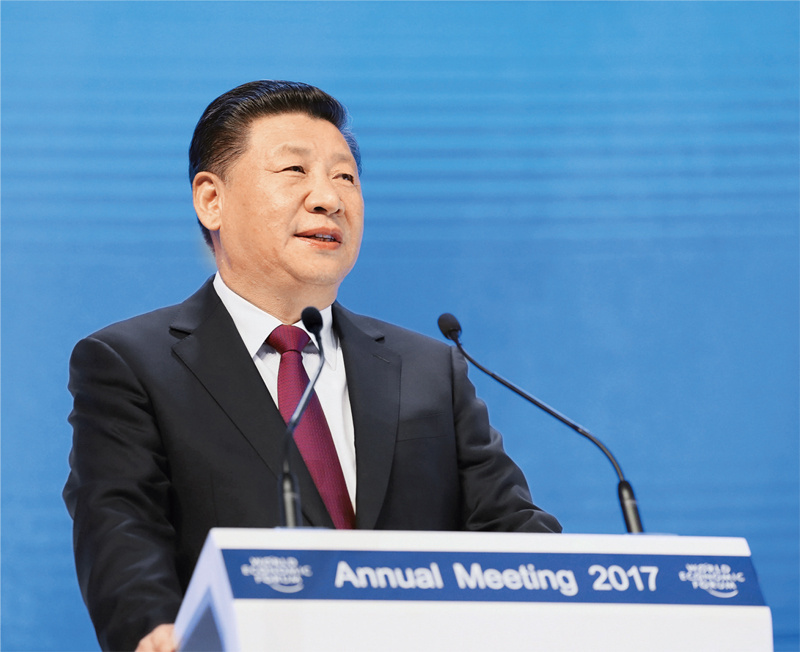
On January 17, 2017, President Xi Jinping attended the opening ceremony of the 2017 annual meeting of the World Economic Forum at the International Conference Center in Davos, Switzerland, and delivered a keynote speech entitled "sharing the responsibility of the times and promoting global development. Xinhua News Agency reporter Lan Hongguang/photo
Honorable Chairman Leuthard and Mr. Howson,
Distinguished Heads of State, Heads of Government, Deputy Heads of State and Madame,
Distinguished heads of international organizations,
Honorable Chairman and Mrs. Schwab,
Ladies and Gentlemen, Friends:
It is a pleasure to come to the beautiful Davos. Although Davos is only a small town in the Alps, it is an important window to observe the world economy. Everyone gathered here from all directions, all kinds of ideas collided with sparks of wisdom, and obtained high output with less input. I think this phenomenon can be called "Schwab economics".
"This is the best of times, but also the worst of times," the British writer Dickens once described the world after the Industrial Revolution. Today, we also live in a world of contradictions. On the one hand, material wealth continues to accumulate, science and technology progress with each passing day, and human civilization has developed to the highest level in history. On the other hand, regional conflicts occur frequently, global challenges such as terrorism and refugee flows emerge one after another, poverty, unemployment and income gap are widening, and the uncertainty facing the world is rising.
In this regard, many people are confused, what is wrong with the world?
To solve this confusion, we must first find the root of the problem. There is a view that blames economic globalization for the chaos in the world. Economic globalization was once regarded as Alibaba's cave, and now it is regarded as Pandora's box by many people. The international community has conducted extensive discussions on the issue of economic globalization.
Today, I would like to start with the issue of economic globalization and talk about my views on the world economy.
What I want to say is that many of the problems plaguing the world are not caused by economic globalization. For example, in the past few years, the tide of refugees from the Middle East and North Africa has affected the world, millions of people have been displaced, and even many young children have died in the sea on the road, which makes us sad. The causes of this problem are wars, conflicts and regional instability. The solution to this problem is to seek peace, promote reconciliation and restore stability. For another example, the international financial crisis is not an inevitable product of the development of economic globalization, but the result of excessive profit-seeking of financial capital and serious lack of financial supervision. Simply blaming economic globalization for the problems plaguing the world is neither in line with the facts nor conducive to the solution of the problem.
From a historical point of view, economic globalization is the objective requirement of the development of social productive forces and the inevitable result of scientific and technological progress, and is not artificially created by any person or country. Economic globalization has provided a strong driving force for world economic growth, promoting the flow of goods and capital, the progress of science and technology and civilization, and the exchanges between people of all countries.
Of course, we must also recognize that economic globalization is a double-edged sword. When the world economy is in a downward period, it is not easy for the global economic cake to become bigger or even smaller, and the contradictions between growth and distribution, capital and labor, efficiency and fairness will become more prominent, and both developed and developing countries will feel the pressure and impact. The voice of anti-globalization reflects the shortcomings of the process of economic globalization, which deserves our attention and deep consideration.
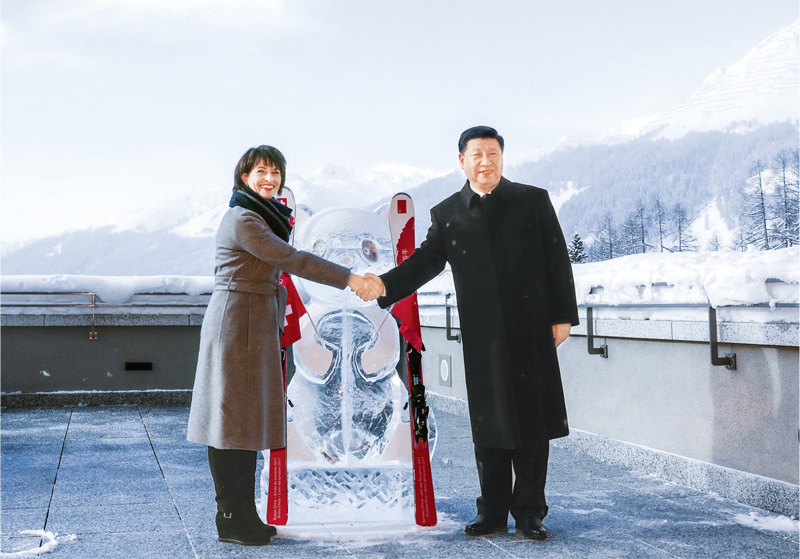
On January 17, 2017, President Xi Jinping and President of the Swiss Confederation Leuthard jointly launched the China-Switzerland Tourism Year in Davos. The two heads of state took a group photo next to the ice statue of a panda and skis printed with the national flags of China and Switzerland and the words "China-Switzerland Tourism Year. Xinhua News Agency reporter Ding Lin/photo
"Gan melon holds bitter pedicles, and beautiful dates give birth to thorns." Philosophically speaking, there is no perfect thing in the world. It is incomplete to regard things as perfect because they have advantages, and it is incomplete to regard them as useless because they have shortcomings. Economic globalization has indeed brought new problems, but we cannot just beat economic globalization to death. Instead, we must adapt and guide economic globalization, eliminate the negative effects of economic globalization, and make it better benefit every country., Every nation.
Back then, China also had doubts about economic globalization and was worried about joining the World Trade Organization. However, we believe that integrating into the world economy is the general direction of history. If China's economy wants to develop, it must dare to swim in the vast ocean of the world market. If you never dare to go to the sea to experience wind and rain and see the world, one day you will Drowned in the sea. Therefore, China has bravely stepped into the world market. In this process, we choked water, encountered whirlpools, encountered wind and waves, but we learned to swim in swimming. This is the right strategic choice.
The sea of the world economy, whether you want it or not, is there and cannot be avoided. It is impossible and not in line with the historical trend to artificially cut off the capital flow, technology flow, product flow, industry flow and personnel flow of various countries' economies and let the sea of the world economy return to isolated small lakes and rivers.
Human history tells us that it is not terrible to have problems. What is terrible is that we dare not face the problems directly and cannot find ways to solve them. In the face of the opportunities and challenges brought about by economic globalization, the correct choice is to make full use of all opportunities, cooperate to meet all challenges, and guide the trend of economic globalization.
At the end of last year, at the informal meeting of APEC leaders, I proposed to make the process of economic globalization more dynamic, inclusive and sustainable. We must take the initiative and manage appropriately, so that the positive effects of economic globalization can be released more, and the process of economic globalization can be rebalanced; we must adapt to the general trend, combine national conditions, and correctly choose the path and rhythm of integration into economic globalization; we must emphasize Efficiency, pay attention to fairness, so that different countries, different classes, and different groups of people can share the benefits of economic globalization. This is not only the responsibility of the leaders of our time, but also the expectation of the people of all countries.
Ladies and gentlemen, friends!
At present, the most urgent task is to lead the world economy out of the predicament. The world economy has been in the doldrums for a long time, and the gap between the rich and the poor and between the North and the South has become more prominent. The root cause is that the three prominent contradictions in the economic field have not been effectively resolved.
First, the global growth momentum is insufficient to support the sustained and stable growth of the world economy.The growth rate of the world economy is at its lowest level in seven years, and the growth rate of global trade continues to be lower than that of the economy. Short-term policy stimulus is not effective, and deep-seated structural reforms are still advancing. The world economy is in a shifting period of kinetic energy conversion. The traditional growth engine's pulling effect on the economy is weakening. Although new technologies such as artificial intelligence and 3D printing continue to emerge, new economic growth points have not yet formed. The world economy is still failing to blaze a new trail.
Second, global economic governance is lagging behind and it is difficult to adapt to the new changes in the world economy.Not long ago, Ms. Lagarde told me that the contribution rate of emerging market countries and developing countries to global economic growth has reached 80%. Over the past few decades, the balance of international economic power has evolved profoundly, while the global governance system has failed to reflect the new pattern, and is not representative and inclusive enough. The global industrial layout is constantly adjusting, and new industrial chains, value chains, and supply chains are increasingly formed, while trade and investment rules have failed to keep up with the new situation, and closed mechanisms and fragmented rules are very prominent. The global financial market needs to enhance its ability to resist risks, and the global financial governance mechanism has failed to adapt to the new needs, and it is difficult to effectively resolve the frequent turbulence in the international financial market and the accumulation of asset bubbles.
Third, global development is unbalanced and it is difficult to meet people's expectations for a better life.In his book The Fourth Industrial Revolution, Mr. Schwab wrote that the fourth industrial revolution will have extremely wide-ranging and far-reaching effects, including increasing inequality, especially the gap between the return on capital and the return on labor. The wealth of the richest 1% of the world's population exceeds the sum of the wealth of the remaining 99% of the population. The inequality of income distribution and the imbalance of development space are worrying. More than 0.7 billion million people still live in extreme poverty. For many families, having warm housing, adequate food and stable work is still a luxury. This is the biggest challenge facing the world today and an important cause of social unrest in some countries.
These problems reflect that there are problems that must be solved in today's world economic growth, governance and development model. Du Nan, the founder of the International Red Cross, said: "The real enemy is not our neighbors, but hunger, poverty, ignorance, superstition and prejudice." We should not only have the wisdom to analyze problems, but also have the courage to take action.
First, adhere to innovation-driven and create a dynamic growth model.The fundamental problem facing the world economy is the lack of growth momentum. Innovation is the first driving force for development. Compared with previous industrial revolutions, the fourth industrial revolution is unfolding at an exponential rather than linear speed. We must find a way out in innovation. Only by daring to innovate and change can we break through the bottleneck of world economic growth and development.
G20 leaders reached an important consensus at the Hangzhou Summit to take innovation as an important starting point and tap new driving forces for economic growth in all countries and the world. We need to innovate the concept of development, go beyond the debate about whether more fiscal stimulus or more monetary easing, and establish the idea of treating both the symptoms and the root causes of the problem and implementing comprehensive policies. We need to innovate policy instruments and promote structural reforms to create room for growth and increase stamina. We should innovate the mode of growth, seize the opportunities brought about by the new round of industrial revolution and digital economy, not only deal with the challenges brought about by climate change and population aging, but also resolve the impact of informatization and automation on employment, and pay attention to creating new employment opportunities in the process of cultivating new industries, new formats and new models, so that people of all countries can regain their confidence and hope.
Second, adhere to collaborative linkage and create an open and win-win cooperation model.Mankind has become a community with a shared future, with a high degree of integration of interests and interdependence. Every country has the right to development, and at the same time, it should consider its own interests at a broader level, not at the expense of the interests of other countries.
We must unswervingly develop an open world economy, share opportunities and benefits in opening up, and achieve mutual benefit and win-win results. You can't retreat to the harbor at the first wind and waves, you can never reach the other side. We must make great efforts to develop global connectivity so that all countries in the world can achieve linked growth and common prosperity. We must unswervingly develop global free trade and investment, promote trade and investment liberalization and facilitation in the course of opening up, and take a clear-cut stand against protectionism. Protectionism is like putting yourself in a dark room. It seems to have escaped the wind and rain, but it also isolates the sun and air. The result of a trade war can only be a loss for both sides.
Third, we should keep pace with the times and create a fair and reasonable governance model.Small wisdom governs affairs, big wisdom governs system. The urgency of the reform of the global economic governance system is becoming more and more prominent, and the voice of the international community is getting louder and louder. The global governance system can only provide a strong guarantee for the global economy if it adapts to the new requirements of the international economic structure.
All countries, big or small, strong or weak, rich or poor, are equal members of the international community and should equally participate in decision-making, enjoy rights and fulfill obligations. It is necessary to give more representation and voice to emerging market countries and developing countries. The 2010 IMF quota reform program has come into effect, and this momentum should be maintained. We must uphold multilateralism and safeguard the authority and effectiveness of the multilateral system. To fulfill the promise and abide by the rules, one cannot choose or choose according to one's own wishes. The "Paris Agreement" is in line with the general direction of global development, and the results are hard-won. We should stick to it together and not give up lightly. This is our responsibility to future generations!
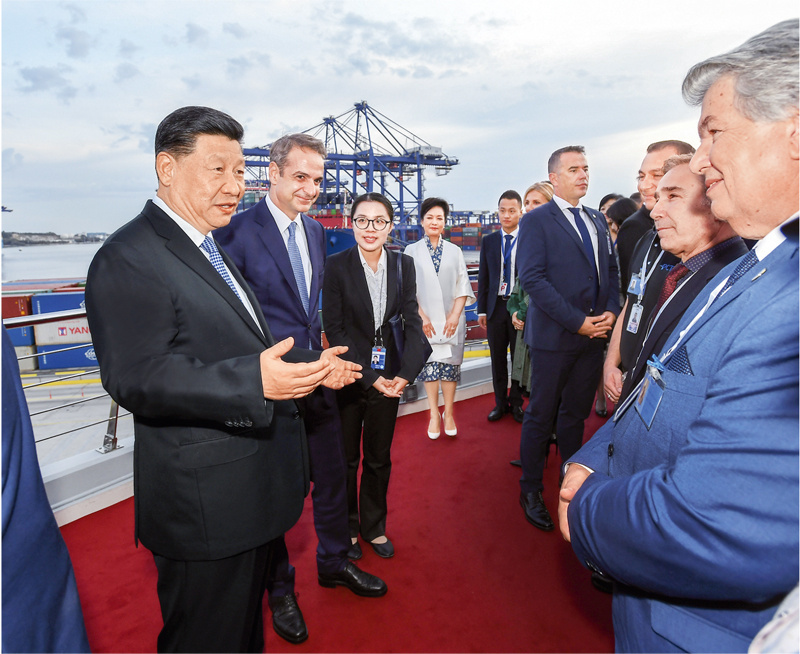
On November 11, 2019 local time, President Xi Jinping and his wife Peng Liyuan, accompanied by Greek Prime Minister Mitsotakis and his wife, visited the COSCO Shipping Piraeus Port Project. This is a cordial conversation between Xi Jinping and local staff representatives, asking about their work and living conditions. Xinhua News Agency reporter Xie Huanchi/Photo
Fourth, adhere to fair and inclusive, and create a balanced and inclusive development model."The world is for the public when you travel on the main road." The purpose of development is to benefit the people. To make development more balanced, to make development opportunities more equal, and to share development results, it is necessary to improve development concepts and models, and enhance development fairness, effectiveness, and synergy.
We should advocate a social atmosphere of diligence, frugality and hard work, so that the fruits of all people's labor can be respected. Efforts should be made to solve the problems of poverty, unemployment and widening income gap, take care of the concerns of vulnerable groups, and promote social equity and justice. It is necessary to protect the ecological environment, promote the coordinated development of economy, society and environment, and realize the harmony between man and nature, man and society. We must implement the United Nations 2030 Agenda for Sustainable Development and achieve balanced development on a global scale.
"If you accumulate your strength, you will be invincible; if you do what all the wisdom does, you will be able to do everything." As long as we firmly establish a sense of a community with a shared future for mankind, work together, take responsibility together, help each other in the same boat, and tide over difficulties together, we will certainly be able to make the world a better place and the people happier.
Ladies and gentlemen, friends!
After 38 years of reform and opening up, China has become the world's second largest economy. The road determines fate. The key to China's development lies in the fact that the Chinese people, under the leadership of the Communist Party of China, have embarked on a development path that suits China's national conditions.
This is a path established from the national conditions.Based on its own national conditions and practice, China draws wisdom from Chinese civilization, draws on the strengths of the East and the West, sticks to it but is not rigid, learns from it but does not copy it, and has formed its own development path through continuous exploration. All roads lead to Rome. No one should set his own development path as one, let alone impose his own development path on others.
This is a path that puts the interests of the people first.China upholds the people-centered development philosophy, takes improving people's lives and enhancing people's well-being as its starting point and goal, and seeks development momentum among the people, relies on the people to promote development, and makes development benefit the people. Adhering to the goal of common prosperity, China has vigorously promoted poverty reduction, lifted more than 0.7 billion people out of poverty, and is making rapid progress towards the goal of building a moderately prosperous society in an all-round way.
This is a path of reform and innovation.China insists on solving the difficulties and challenges encountered in its progress through reform, dares to gnaw hard bones and dangerous shoals, and has the courage to break down the institutional and institutional obstacles that hinder development, constantly liberate and develop social productive forces, and constantly liberate and enhance social vitality. Over the past four years, we have launched more than 1200 reform measures on the basis of continuous reform over the past 30 years, which has injected strong impetus into China's development.
This is a way to seek common development through opening up.China adheres to the basic national policy of opening up to the outside world, pursues a mutually beneficial and win-win opening strategy, and continuously enhances the internal and external linkages of development, so as to achieve its own development while benefiting other countries and peoples.
China has made great achievements in development, and the lives of the Chinese people have been greatly improved. This is good for China and good for the world. China's development achievements are the result of decades of hard work, blood and sweat by the Chinese people. For thousands of years, the Chinese nation has been known for its hard work. The Chinese people are well aware that there is no free lunch in the world. China is a large country with a population of more than 1.3 billion. If you want to develop, you must rely on your own hard work and cannot rely on the gifts of others. No one in the world has such ability.
To observe China's development, we should look at what the Chinese people have gained, more importantly, what hard work the Chinese people have put in; what achievements China has made, and more importantly, what contribution China has made to the world. This is a comprehensive view.
From 1950 to 2016, under the circumstances that China's long-term development level and people's living standards were not high, China provided a total of more than 400 billion billion yuan in foreign aid, implemented more than 5000 foreign aid projects of various types, including nearly 3000 complete sets of projects, and held more than 11000 training courses to train more than 260000 personnel of various types for developing countries in China. Since the reform and opening up, China has attracted more than 1.7 trillion US dollars of foreign investment and more than 1.2 trillion US dollars of foreign direct investment, which has made great contributions to the development of the world economy. Since the outbreak of the international financial crisis, the contribution rate of China's economic growth to world economic growth has been more than 30% annually. These numbers are among the best in the world.
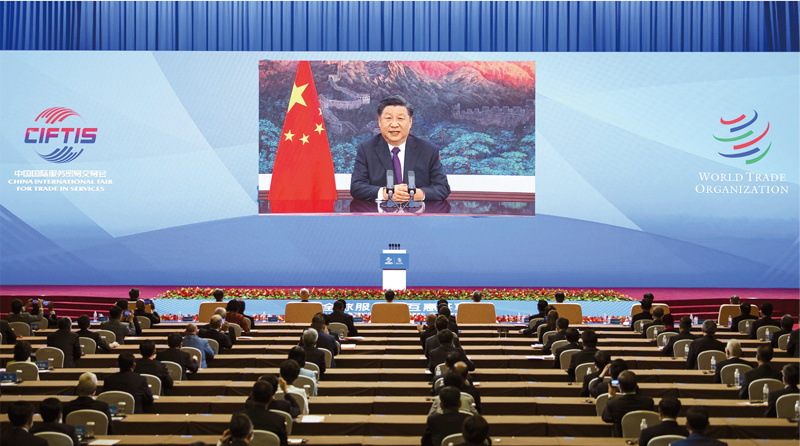
On September 4, 2020, President Xi Jinping delivered a speech at the 2020 China International Service Trade Fair Global Service Trade Summit. Xinhua News Agency reporter Li Tao/Photo
From these figures, we can see that China's development is an opportunity for the world, and China is not only a beneficiary of economic globalization, but also a contributor. China's rapid economic growth has provided a continued strong impetus to global economic stability and growth. The joint development of China with a large number of countries has made the global economic development more balanced. China's tremendous achievements in poverty reduction have made global economic growth more inclusive. The continuous progress of China's reform and opening up has provided an important impetus for the development of an open world economy.
The Chinese people are well aware of the hardships of achieving national prosperity and strength. They praise the development achievements of the people of all countries and wish them well. They all hope that their life will be better and better. They will not commit "red eye" and will not complain that others have gained great opportunities and rich returns from China's development. The Chinese people welcome people from all over the world with open arms to take the "express train" and "free ride" of China's development ".
Ladies and gentlemen, friends!
Many people are concerned about China's economic development trend. China's economic development has entered a new normal, and major changes are taking place in economic growth, economic development mode, economic structure and economic development momentum. However, the fundamentals of China's long-term economic improvement have not changed.
In 2016, against the background of the weak world economy, China's economy is expected to grow by 6.7, which is still in the forefront of the world. At present, the size of China's economy is no longer the same as in the past, and the momentum of agglomeration is not reached by double-digit growth in the past. Chinese residents' consumption and service industry have become the main driving force of economic growth. In the first three quarters of 2016, the added value of the tertiary industry accounted for 52.8 percent of GDP, and the contribution rate of domestic consumption to economic growth reached 71%. Residents' income and employment have achieved steady growth, energy consumption per unit of GDP has continued to decline, and green development has begun to bear fruit.
At present, China's economy is facing certain downward pressure and many difficulties, such as the prominent contradiction between overcapacity and the upgrading of demand structure, the lack of endogenous driving force for economic growth, the accumulation of financial risks, and the increase of difficulties in some areas. We believe that these are inevitable phased phenomena in the course of progress, and we are making great efforts to solve these problems and contradictions, and continue to achieve positive results. Our firm determination to move forward will not waver. China is still the largest developing country in the world. China has a population of more than 1.3 billion and its people's living standards are not high, but this also means huge development potential and space. Under the guidance of the development concept of innovation, coordination, green, openness and sharing, we will continue to adapt to, grasp and lead the new normal of China's economic development, make overall efforts to stabilize growth, promote reform, adjust structure, benefit people's livelihood and prevent risks, so as to promote China's economy to maintain medium and high-speed growth and move towards the middle and high-end level.
-- China will focus on improving the quality and efficiency of economic growth, focusing on the main line of supply-side structural reform, transforming the mode of economic development, optimizing the economic structure, and actively promoting the elimination of production capacity, inventory, deleveraging, cost reduction, and shortcomings. Cultivate new growth momentum, develop advanced manufacturing, realize the upgrading of the real economy, in-depth implementation of the "Internet" action plan, and expand effective demand, better meet people's personalized and diversified needs, and better protect the ecological environment.
-- China will continue to stimulate growth momentum and market vitality, intensify reforms in important areas and key links, let the market play a decisive role in resource allocation, hold the "bull nose" of innovation, promote innovation-driven development strategies, and promote strategic emerging Industrial development, focusing on the transformation and upgrading of traditional industries with new technologies and new business formats, promoting the development and growth of new kinetic energy, and revitalizing traditional kinetic energy.
-China will actively create a relaxed and orderly investment environment, relax foreign investment access, build high-standard free trade pilot zones, strengthen property rights protection, promote fair competition, and make the Chinese market more transparent and standardized. It is estimated that in the next five years, China will import 8 trillion US dollars of goods and absorb 600 billion US dollars of foreign investment. The total amount of foreign investment will reach 750 billion US dollars, and the number of outbound tourists will reach 0.7 billion. This will provide countries around the world with a broader market, more adequate capital, richer products and more valuable opportunities for cooperation. For the business community of all countries, China's development is still an opportunity for everyone. China's door is always open to the world and will not be closed. Open the door, the world can enter China, China can also go to the world. We hope that the doors of all countries will also be fairly open to Chinese investors.
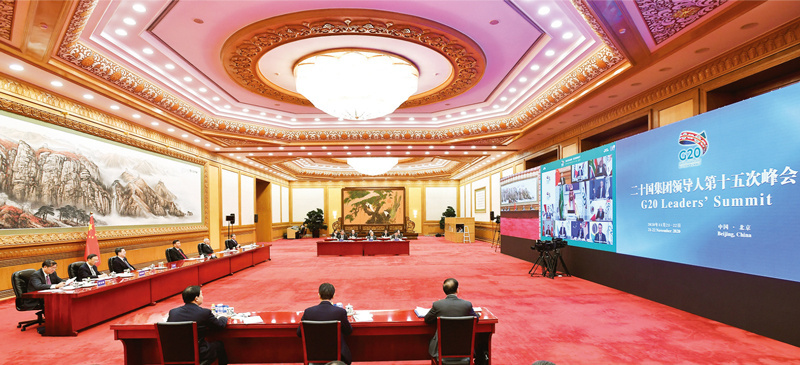
On the evening of November 22, 2020, President Xi Jinping attended the second phase of the 15th G20 Summit in Beijing by video, focusing on his views on sustainable development. Xinhua News Agency reporter Li Xiang/Photo
-- China will vigorously build a pattern of opening up to the outside world for common development, promote the construction of the Asia-Pacific Free Trade Area and the negotiation of the Regional Comprehensive Economic Partnership Agreement, and build a global network of free trade areas. China has always advocated the construction of open, transparent, mutually beneficial and win-win regional free trade arrangements, rather than engaging in exclusive and fragmented small circles. China has no intention to enhance its trade competitiveness through the devaluation of the renminbi, let alone take the initiative to fight a currency war.
More than three years ago, I put forward the "the belt and road initiative" initiative. Over the past three years, more than 100 countries and international organizations have actively responded to support, more than 40 countries and international organizations have signed cooperation agreements with China, and the "circle of friends" of the "Belt and Road" is constantly expanding. Chinese enterprises have invested US $more than 50 billion billion in countries along the route, and a series of major projects have blossomed, driving the economic development of various countries and creating a large number of employment opportunities. It can be said that the "the belt and road initiative" initiative comes from China, but its results benefit the world.
In May of this year, China will host the "Belt and Road" International Cooperation Summit Forum in Beijing to discuss cooperation plans, build cooperation platforms, share cooperation results, find solutions to the current problems facing the world and regional economies, and achieve joint development. Inject new energy and make the "Belt and Road" construction better benefit the people of all countries.
Ladies and gentlemen, friends!
The development of world history tells us that there has never been a smooth road to the progress of human civilization, and that mankind is advancing in the struggle against difficulties. No matter how difficult it is, it is impossible to stop the pace of human progress. Encountered difficulties, do not blame yourself, do not blame others, do not give up confidence, do not evade responsibility, but to overcome difficulties together. History is created by the brave. Let us show confidence, take action, hand in hand toward the future!
Thank you all.
※ this is the keynote speech delivered by General Secretary Xi Jinping at the opening ceremony of the 2017 Annual Meeting of the World Economic Forum held in Davos, Switzerland on January 17, 2017.
Keywords:

Contact Information
Phone:400-906-6996 (Contact Number)
Phone:86-13545719507 (Mr. Shao)
Email:baifeng@sinoma-ec.cnlijie@sinoma-ec.cn

WeChat Official Account

WeChat Video Channels

Official TikTok

Product Color Chart