

Blogs
Follow Sinoma Energy Saving to learn about the latest information of the company
The Ministry of Emergency Management of the the People's Republic of China prohibits flammable and combustible materials from being used as exterior insulation materials for high-rise civil buildings!
Release date:
2021-06-29
Author:
Source:
Integral Board Branch
Recently, the Ministry of Emergency Management of the the People's Republic of China of Civil Affairs issued the regulations on Fire Safety Management of High-rise Civil buildings, in which Article 19 stipulates that it is forbidden to use flammable and combustible materials as exterior insulation materials for high-rise civil buildings. For high-rise civil buildings that use non-flammable exterior insulation materials or use exterior insulation systems with cavities between the grass-roots walls and decorative layers, it is forbidden to use electricity for fire on their exterior walls. The regulations will come into force on August 1, 2021.
Recently, the Ministry of Emergency Management of the the People's Republic of China of Civil Affairs issued the regulations on Fire Safety Management of High-rise Civil buildings, in which Article 19 stipulates that it is forbidden to use flammable and combustible materials as exterior insulation materials for high-rise civil buildings. For high-rise civil buildings that use non-flammable exterior insulation materials or use exterior insulation systems with cavities between the grass-roots walls and decorative layers, it is forbidden to use electricity for fire on their exterior walls. The regulations will come into force on August 1, 2021.
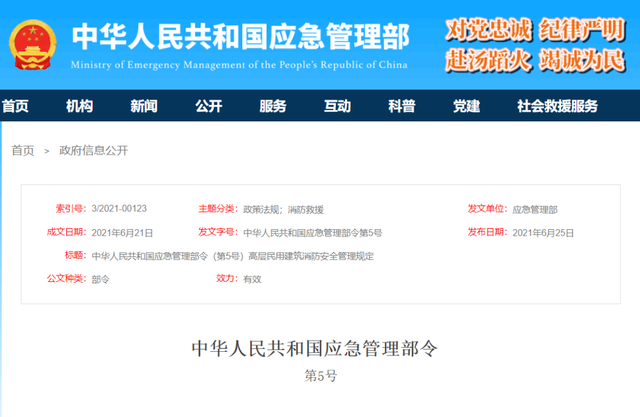
The original text reads as follows:
Order of the People's Republic of China Emergency Management Department
No. 5
The Provisions on the Administration of Fire Safety of High-rise Civil Buildings, as deliberated and adopted at the 39th executive meeting of the Ministry of Emergency Management on December 28, 2020, are hereby issued, and shall come into force on August 1, 2021.
Minister Huang Ming
June 21, 2021
Regulations on Fire Safety Management of High-rise Civil Buildings
Chapter I General Provisions
Article 1 These Provisions are formulated in accordance with the the People's Republic of China Fire Protection Law and other laws and administrative regulations and the relevant provisions of the State Council in order to strengthen the management of fire safety in high-rise civil buildings, prevent fires and reduce fire hazards.
Article 2 These Provisions shall apply to the fire safety management of high-rise civil buildings (including high-rise residential buildings and high-rise public buildings) that have been built and put into use according to law.
Article 3 The fire safety management of high-rise civil buildings shall implement the policy of focusing on prevention and combining prevention and fire, and implement the fire safety responsibility system. High-rise civil buildings with a building height of more than 100 meters shall be subject to stricter fire safety management.
Chapter II Fire Safety Duties
Article 4 The owners and users of high-rise civil buildings are the main body responsible for the fire safety of high-rise civil buildings and are responsible for the fire safety of high-rise civil buildings. If the owner or user of a high-rise civil building is a unit, its legal representative or main person in charge is the person responsible for fire safety of the unit.
Owners and users of high-rise civil buildings may entrust professional service units such as property service enterprises or fire technical service institutions (hereinafter collectively referred to as fire service units) to provide fire safety services, and shall stipulate the specific contents of fire safety services in the service contract.
Article 5 If there are two or more owners and users of the same high-rise civil building, each owner and user shall be responsible for the fire safety of its exclusive part and jointly responsible for the fire safety of the common part.
If there are two or more owners and users of the same high-rise civil building, they shall jointly entrust a property service enterprise, or specify one owner or user as a unified manager, implement unified management of the fire safety of the common part, coordinate and guide the owners and users to do a good job in the fire safety work of the whole building, and agree on the fire safety responsibilities of all parties in writing.
Article 6 Where a high-rise civil building is used by a contractor, lessee or management manager in the form of contracting, leasing or entrusting operation or management, the parties shall clarify the fire safety responsibilities of all parties when entering into contracts such as contracting, leasing or entrusting management. The entrusting party and the lessor may, in accordance with the provisions of the law, coordinate and manage the fire safety work of the contractor, the lessee and the trustee.
When contracting, leasing or entrusting operation and management, the owner shall provide buildings that meet the fire safety requirements and urge the user to strengthen the fire safety management.
Article 7 The owner units and user units of high-rise public buildings shall perform the following fire safety duties:
(I) comply with fire laws and regulations, establish and implement fire safety management system;
(II) specify the fire safety management institution or fire safety management personnel;
(III) organize and carry out fire prevention patrol and inspection to eliminate fire hazards in time;
(IV) ensure that the evacuation channel, safety exit and fire truck channel are unblocked;
(V) regularly inspect and maintain the building fire-fighting facilities and equipment to ensure that they are in good condition and effective;
(VI) organize fire protection publicity, education and training, formulate fire fighting and emergency evacuation plans, and organize fire drills on a regular basis;
(VII) the establishment of full-time fire brigades, volunteer fire brigades (mini fire stations) and other fire fighting organizations in accordance with the provisions;
(VIII) other fire safety duties as required by laws and regulations.
If a property service enterprise is entrusted or a unified manager is clearly defined to implement fire safety management, the property service enterprise or unified manager shall perform the fire safety duties specified in the preceding paragraph in accordance with the agreement, the owner unit and the user unit shall supervise and cooperate with the property service enterprise or the unified manager to do a good job in fire safety.
Article 8 The owner, user, property service enterprise or unified manager of a high-rise public building shall specify a special person as the fire safety manager, responsible for the fire safety management of the whole building, and publicize his name, contact information and fire safety management responsibilities in a prominent position of the building.
Fire safety managers of high-rise public buildings shall perform the following fire safety management duties:
(I) formulate annual fire control work plan and organize the implementation of daily fire control safety management;
(II) organize and carry out fire prevention inspection, patrol and rectification of fire hazards;
(III) organize and implement the maintenance of fire-fighting facilities and equipment shared by the building;
(IV) and manage full-time fire brigade, volunteer fire brigade (mini fire station) and other fire fighting organizations;
(V) organize publicity, education and training on fire safety;
(VI) organize the preparation of comprehensive plans for fire fighting and emergency evacuation and conduct drills.
The fire safety managers of high-rise public buildings shall have the fire safety knowledge and management ability corresponding to their duties. For high-rise public buildings with a height of more than 100 meters, relevant units are encouraged to employ registered fire engineers at the corresponding level or personnel with intermediate or above professional and technical positions in relevant engineering as fire safety managers.
Article 9 The owners and users of high-rise residential buildings shall perform the following fire safety obligations:
(I) comply with the fire safety matters stipulated in the Convention on Fire Safety and Management of Residential Quarters;
(II) use of the building for the purposes stated in the certificate of ownership of the immovable property;
(III) cooperate with fire service units to do a good job of fire safety;
(IV) bear the costs of fire fighting services and the related costs of maintenance, renewal and alteration of building fire fighting facilities in accordance with the provisions of the law;
(V) maintain fire safety, protect fire facilities, prevent fires, report fires, and adults participate in organized fire fighting;
(VI) other fire safety obligations stipulated by laws and regulations.
Article 10 The entrusted property service enterprises of high-rise residential buildings shall perform the following fire safety duties according to law:
(I) implement fire safety responsibilities, formulate fire safety systems, and draw up annual fire safety work plans and organizational guarantee plans;
(II) specify specific departments or personnel to be responsible for fire safety management;
(III) regularly inspect and maintain the common fire-fighting facilities, equipment and fire-fighting signs in the management area to ensure that they are in good condition and effective;
(IV) organize and carry out fire prevention patrol and inspection to eliminate fire hazards in time;
(V) ensure the smooth flow of evacuation passages, safety exits, and fire truck passages, and stop violations such as occupying, blocking, and closing evacuation passages, safety exits, and fire truck passages; if the stop is invalid, timely report to the fire rescue agency and other relevant administrative departments for handling according to law;
(VI) urge the owners and users to fulfill their fire safety obligations;
(VII) regularly report the fire safety situation to the owners' committee, owners and users of the residential area where they are located, and remind them of fire safety risks;
(VIII) organize and carry out regular fire prevention publicity and education;
(IX) formulate fire fighting and emergency evacuation plans, and organize regular drills;
(X) other fire safety responsibilities stipulated by laws, regulations and contracts.
Article 11 Fire and rescue agencies and other agencies responsible for fire supervision and inspection shall conduct fire supervision and inspection of high-rise civil buildings in accordance with the law, and urge owners, users, and entrusted fire service units to implement fire safety responsibilities; fire hazards discovered during supervision and inspection Notify relevant units or individuals to take immediate measures to eliminate hidden dangers.
Fire and rescue agencies shall strengthen the publicity of fire safety laws and regulations on high-rise civil buildings, supervise and guide relevant units to do a good job in the publicity and education of fire safety of high-rise civil buildings.
Article 12 Villagers' committees and residents' committees shall organize the formulation of fire safety conventions in accordance with the law, conduct fire safety inspections of high-rise civil buildings, assist the people's government and relevant departments to strengthen fire protection publicity and education; carry out targeted fire protection publicity and education for the elderly, minors, and the disabled, and strengthen fire safety assistance.
Article 13 Professional operating units such as water supply, power supply, gas supply, heating, communications, and cable television shall be responsible for the fire safety of facilities and equipment under their management in high-rise civil buildings in accordance with the law, and shall conduct regular inspections and maintenance.
Chapter III Fire Safety Management
Article 14 During the construction of high-rise civil buildings, the construction unit shall clarify the fire safety responsibilities of the construction site with the construction unit. During the construction period, on-site preventive measures shall be strictly implemented, fire-fighting equipment shall be equipped, special personnel shall be designated for supervision, and fire-prevention separation measures shall be taken, which shall not affect the safe evacuation of personnel in other areas and the normal use of building fire-fighting facilities.
The owners and users of high-rise civil buildings shall not change the use function of the building, change the fire and smoke prevention zoning without authorization, and shall not use flammable and combustible decoration materials in violation of the fire technical standards.
Article 15 The owners, users, property service enterprises and unified managers of high-rise civil buildings shall implement strict fire safety management on the use of open fire operations, and shall not use open fire in places with fire and explosion hazards; due to special circumstances such as construction, where open fire operations such as electric welding and gas welding are required, hot work approval procedures shall be handled in accordance with regulations, on-site guardians shall be implemented, and fire fighting equipment shall be equipped, announcements shall be made at the main entrance of the building and at a prominent position on the work site. Operators shall take up their posts with certificates in accordance with the law, strictly abide by the fire safety regulations, remove flammable and combustible materials around and below, and take fire isolation measures. After the operation is completed, a comprehensive inspection shall be carried out to eliminate the remaining kindling.
High-rise public buildings in the shopping malls, public entertainment venues shall not be hot during the business period of construction. In high-rise public buildings, no fire and no smoking areas shall be determined and obvious signs shall be set up.
Article 16 The installation and use of electrical equipment in high-rise civil buildings and the laying, maintenance and testing of their lines shall comply with the technical standards and management regulations on fire protection.
The owners, users or fire service units of high-rise civil buildings shall arrange professional institutions or electricians to regularly inspect the electrical equipment and lines under their management in the management area; if they do not meet the safety requirements, they shall be repaired and replaced in time.
Article 17 The installation and use of gas appliances in high-rise civil buildings and the laying, maintenance and testing of their pipelines shall comply with fire control technical standards and management regulations. It is forbidden to install, modify or dismantle gas equipment and appliances without authorization in violation of the regulations on the safe use of gas.
The use of gas in high-rise civil buildings shall be in the form of pipeline gas supply. The use of liquefied petroleum gas in the underground part of high-rise civil buildings is prohibited.
Article 18 It is prohibited to produce, store and deal in Class A and B fire hazardous articles in high-rise civil buildings in violation of State regulations.
Article 19 For high-rise civil buildings with exterior insulation systems, the management unit shall set up prompt and warning signs at the main entrance and the relevant prominent positions around the building to indicate the combustion performance and fire protection requirements of exterior insulation materials. Damage, cracking and falling off of the external thermal insulation system of the external walls of high-rise civil buildings shall be repaired in a timely manner. In the construction of external thermal insulation system of high-rise civil buildings, the construction unit shall take necessary measures to prevent fire and isolate and restrict the use of residents to ensure the safety of personnel in the building.
It is forbidden to use flammable and combustible materials as exterior insulation materials for high-rise civil buildings. It is prohibited to set off fireworks and firecrackers in the building and surrounding prohibited areas; it is prohibited to pile up combustible materials around its external walls. For high-rise civil buildings that use flame-retardant external wall insulation materials or use external wall insulation systems with cavities between the base wall and decorative layer, it is forbidden to use electricity for hot work on their external walls.
Article 20 Vertical pipe wells and cable trays such as cable wells and pipe wells of high-rise civil buildings shall be blocked by fire prevention at each floor, and fire doors shall be used for inspection of pipe wells.
It is forbidden to occupy cable wells and pipeline wells, or pile up sundries in vertical pipe wells such as cable wells and pipeline wells.
Article 21 The outdoor billboards and exterior decorations of high-rise civil buildings shall not use flammable and combustible materials, shall not hinder smoke prevention and exhaust, escape, fire fighting and rescue, and shall not change or damage the fire prevention structure of the building facade.
It is forbidden to set up obstacles that affect escape and fire fighting and rescue in the external windows of high-rise civil buildings.
The decorations and billboards set on the exterior walls of high-rise civil buildings with a building height of more than 50 meters shall be made of non-combustible materials and be easy to break down.
Article 22 It is forbidden to set up obstacles such as structures, parking spaces, and fixed isolation piles in the fire truck passage and the fire truck climbing operation site.
It is forbidden to set obstacles such as overhead pipelines, billboards and decorations that hinder the operation of fire engines above the passage of fire engines and on the climbing operation surface.
Article 23 The operating units of catering establishments in high-rise public buildings shall clean the kitchen stoves and fume exhaust hood facilities in a timely manner, and the fume exhaust pipes shall be inspected and cleaned at least once a quarter.
Public fume exhaust pipes of high-rise residential buildings shall be inspected regularly and fire prevention measures shall be taken.
Article 24 It is prohibited to set up other warehouses in high-rise civil buildings, except for the temporary storage warehouses, archives and reference rooms for self-use articles set up to meet the use functions of high-rise civil buildings.
The auxiliary storehouses of high-rise civil buildings shall take corresponding fire prevention and separation measures and strictly abide by the relevant fire safety management regulations.
Article 25 The boiler room, power transformation and distribution room, air conditioning room, self-provided generator room, oil storage room, fire water pump room, fire water tank room, smoke prevention and exhaust fan room and other equipment rooms in high-rise civil buildings shall be set up in accordance with fire technical standards, identified as key parts of fire safety, set up obvious fire prevention signs, implement strict management, and shall not occupy or pile up sundries.
Article 26 The fire control room of a high-rise civil building shall be subject to a 24-hour duty system by its management unit, and each shift shall not be less than 2 persons on duty.
The operator on duty in the fire control room shall obtain the corresponding level of professional qualification certificate for the specific type of work in the fire control industry in accordance with the law, master the fire disposal procedures and requirements, and check the operation of automatic fire control facilities and linkage control equipment in accordance with relevant regulations to ensure that they are in normal working condition.
The fire control room shall keep the general layout of high-rise civil buildings, the layout plan and the system diagram of fire-fighting facilities and the description of the control logic relationship, the maintenance records and inspection reports of the building fire-fighting facilities.
Article 27 The relevant units in high-rise public buildings, community residents committees where high-rise residential buildings are located, or property service companies established in accordance with regulations, such as full-time fire brigades, voluntary fire brigades (micro fire stations) and other fire protection organizations, shall be equipped with necessary personnel and places With equipment and equipment, regular fire fighting skills training and drills, fire prevention inspections, fire prevention publicity, and timely disposal and fighting of initial fires.
Article 28 Evacuation passages and safety exits of high-rise civil buildings shall be kept unblocked, and it is forbidden to pile up articles, lock exits and set up obstacles. At ordinary times, it is necessary to control the access of personnel or the evacuation door with access control system, which should be easy to open in case of fire, and eye-catching prompts and use signs should be set up in prominent positions on the site.
The normally closed fire doors of high-rise civil buildings shall be kept normally closed, and the door closers, sequencers and other components shall be in good condition and effective; the normally open fire doors shall ensure automatic closing and feedback signals in case of fire.
It is forbidden to occupy or cover the fire hydrant, pile up sundries in the fire hydrant box, and pile up articles under the fire shutter.
Article 29 Signs shall be set up in prominent positions in high-rise civil buildings to indicate the location of the refuge floor (room).
It is forbidden to occupy the refuge floor (room) and refuge walkway of high-rise civil buildings or pile up sundries, and it is forbidden to lock the entrance and exit of the refuge floor (room) and refuge walkway.
Article 30 The owners and users of high-rise public buildings shall, in accordance with national standards and industry standards, be equipped with fire-fighting equipment, self-rescue breathing apparatus, escape mitigation apparatus, escape ropes and other escape and evacuation facilities and equipment.
High-rise residential buildings should be placed in a prominent position in the public area fire-fighting equipment, conditional configuration of self-rescue breathing apparatus, escape rope, rescue post, evacuation flashlight and other escape facilities and equipment.
Encourage the residents of high-rise residential buildings to develop fire evacuation plans, and configure the necessary fire fighting and evacuation equipment.
Article 31 The fire truck passageway of high-rise civil buildings, the fire truck climbing operation site, the fire fighting and rescue window, the fire fighting and rescue demolition port, the fire truck water intake, the outdoor fire hydrant, the fire pump adapter, the normally closed fire door, etc. shall be set up with obvious prompt and warning signs. Fire truck access, fire truck climbing operation site, under the fire shutter should also be marked on the ground to prohibit the occupation of the area. The fire hydrant box and fire extinguisher box shall be posted with the identification of the method of use.
The power switch of the power distribution cabinet of the fire-fighting facilities of high-rise civil buildings, the pipeline valves in the fire-fighting equipment rooms, etc. shall be marked on and off. For valves that need to be kept normally open or normally closed, lead sealing and other limiting measures shall be taken.
Article 32 owners, users or property service enterprises of high-rise civil buildings that do not have the ability to maintain and detect independently shall employ fire-fighting technical service institutions or fire-fighting facilities construction and installation enterprises with employment conditions to carry out maintenance and inspection of building fire-fighting facilities; if there are faults or defects, they shall immediately organize maintenance and replacement to ensure that they are in good condition and effective.
If building fire-fighting facilities need to be stopped due to maintenance, the management unit of high-rise civil buildings shall strictly perform internal examination and approval procedures, formulate emergency plans, implement preventive measures, and make announcements at prominent locations such as the entrance of the building.
Article 33 The cost of maintenance, renewal and renovation of fire-fighting facilities in high-rise public buildings shall be borne by the owners and users in accordance with the relevant laws and regulations, and the common part shall be borne in proportion to the construction area of the exclusive part.
The daily operation, maintenance and repair, renewal and renovation costs of fire-fighting facilities of high-rise residential buildings shall be borne by the owners in accordance with the provisions of the law; if a fire-fighting service unit is entrusted, the daily operation, maintenance and testing costs of fire-fighting facilities shall be included in the special expenses of property services or fire-fighting technical services. The cost of maintenance, renewal and renovation of shared fire-fighting facilities may be charged from the special maintenance funds for residential buildings in accordance with the law.
Article 34 High-rise civil buildings shall conduct daily fire prevention inspections and fill in inspection records. Among them, public gathering places in high-rise public buildings should conduct fire prevention inspections at least every 2 hours during the business period. Hospitals, nursing homes, boarding schools, and kindergartens should conduct fire prevention inspections during the day and night. High-rise residential buildings and other places in high-rise public buildings The frequency of fire prevention inspections can be determined based on actual conditions.
The fire prevention inspection shall include the following contents:
(I) whether the use of fire, electricity and gas is in violation of regulations;
Smooth conditions of (II) safety exits, evacuation passages and fire truck passages;
(III) fire-fighting facilities and equipment in good condition and normally closed fire doors;
(IV) the situation of personnel in key fire safety positions.
Article 35 High-rise residential buildings shall carry out fire prevention inspection at least once a month, and high-rise public buildings shall carry out fire prevention inspection at least once every half a month, and fill in the inspection records.
The fire inspection shall include the following:
(I) safety exits and evacuation facilities;
(II) fire truck access, climbing operation site and fire water source;
(III) the configuration and effectiveness of fire-fighting equipment;
(IV) the implementation of the management system for the use of fire, electricity, gas and dangerous goods;
(V) the duty of fire control room and the operation of fire control facilities;
Education and training of (VI) personnel;
(VII) the management of key parts;
(VIII) the rectification of fire hazards and the implementation of preventive measures.
Article 36 The owners, users and entrusted fire control service units of high-rise civil buildings shall immediately take measures to rectify the hidden fire hazards found in fire prevention inspections and inspections.
For fire hazards that cannot be corrected on the spot, the responsibility and time limit for rectification shall be clarified, and rectification measures shall be implemented. During the rectification period, temporary preventive measures shall be taken to ensure fire safety; when necessary, the use of dangerous parts shall be temporarily stopped.
Article 37 It is forbidden to park electric bicycles or charge electric bicycles in public halls, evacuation walkways, stairwells and safety exits of high-rise civil buildings.
Encourage the establishment of centralized storage and charging places for electric bicycles in high-rise residential areas. Electric bicycle storage and charging places should be set up independently, and keep a safe distance from high-rise civil buildings; if it is really necessary to set up in high-rise civil buildings, it should be separated from other parts of the building for fire prevention.
Electric bicycle storage, charging place should be equipped with the necessary fire equipment, charging facilities should have full automatic power-off function.
Thirty-eighth encourage high-rise civil buildings to promote the application of the Internet of things and intelligent technical means to electrical, gas fire safety and fire control facilities operation monitoring and early warning.
High-rise residential buildings without automatic fire-fighting facilities are encouraged to install fire-fighting facilities such as fire alarm and sprinkler systems, fire emergency broadcasting, combustible gas detection, wireless manual fire alarm, wireless sound and light fire alarm, etc. according to local conditions.
Article 39 The owner, user or fire service unit or unified manager of a high-rise civil building shall organize at least one fire safety assessment of the entire building every year. The fire safety assessment report shall include the existing fire safety problems, fire hazards and improvement measures.
Article 40 Encourage and guide the owners and users of high-rise public buildings to take out public liability insurance for fire.
Chapter IV Fire Protection Publicity and Education and Fire Fighting and Emanding Plans
Article 41 Units in high-rise public buildings shall conduct fire safety education and training for employees at least once every six months.
Units in high-rise public buildings shall conduct pre-employment fire safety training for their employees, and organize special training for fire safety management personnel, fire control room duty personnel and operators, electricians, security guards and other key positions.
Property service enterprises of high-rise residential buildings shall conduct fire safety education and training for residents at least once a year and conduct evacuation drills.
Article 42 High-rise civil buildings shall post safety evacuation schematic diagrams at prominent positions on each floor, and electronic display screens in public areas shall broadcast fire safety prompts and fire safety knowledge.
In addition to complying with the provisions of the first paragraph of this article, high-rise public buildings shall also remind the public to pay attention to the fire danger at a prominent position on the first floor, as well as the location of safety exits, evacuation routes and fire extinguishing equipment.
In addition to complying with the provisions of the first paragraph of this article, high-rise residential communities shall also set up fire safety publicity boards in prominent locations, and prompt the safe use of fire, electricity, gas, and electric bicycle storage and charging at the entrance of high-rise residential building units. Common sense of fire safety.
Article 43 High-rise civil buildings shall, in the light of the characteristics of the site, prepare fire-fighting and emergency evacuation plans at different levels and categories.
For high-rise public buildings with large scale or complex functional formats and two or more owners, users or multiple functional departments, relevant units shall prepare general plans for fire fighting and emergency evacuation, and each unit or functional department shall prepare special fire fighting and emergency evacuation plans or on-site disposal plans (hereinafter collectively referred to as sub-plans) according to the actual sites, functional zones and posts.
The fire fighting and emergency evacuation plan shall specify the emergency organization, determine the personnel and their responsibilities for communication, fire fighting, evacuation and rescue tasks, and clarify the procedures and measures for alarm, liaison, fire fighting and evacuation.
Article 44 The owners, users and entrusted fire service units of high-rise civil buildings shall, in combination with the actual situation, organize and implement fire drills respectively in accordance with the general plan and sub-plan for fire fighting and emergency evacuation.
High-rise civil buildings shall conduct a full-element comprehensive exercise at least once a year, and high-rise public buildings with a building height of more than 100 meters shall conduct a full-element comprehensive exercise at least once every six months. Where sub-plans are prepared, the relevant units and functional departments shall conduct comprehensive drills or special fire fighting and evacuation drills at least once a quarter.
Before the drill, the relevant units shall inform the personnel within the scope of the drill and make an announcement; during the drill, obvious signs shall be set up; after the drill, a summary and evaluation shall be carried out, and the plan shall be revised and improved in a timely manner.
Article 45 In densely populated places in high-rise public buildings, evacuation guides shall be determined according to floors and areas, and shall be responsible for organizing and guiding the safe evacuation of people present in the event of a fire.
Article 46 In the event of a fire, the person who discovers the fire shall immediately call 119 to call the police.
After a fire occurs, the owners, users and fire service units of high-rise civil buildings shall quickly start fire fighting and emergency evacuation plans, organize personnel evacuation, and put out the initial fire.
After the fire is extinguished, the owners, users and fire control service units of high-rise civil buildings shall organize the protection of the fire scene and assist in the fire investigation.
Chapter V Legal Liability
Article 47 Anyone who violates these regulations and commits one of the following acts shall be ordered by the fire rescue agency to make corrections, and a fine of 2000 yuan up to 10000 yuan shall be imposed on business units and individuals, and non-business units and individuals shall be fined 500 yuan up to 1000 yuan. Fines:
(I) conducting open fire operations such as electric welding and gas welding in high-rise civil buildings, failing to perform hot work approval procedures, making announcements, or failing to implement fire protection on-site monitoring measures;
(II) outdoor billboards and exterior decorations set up in high-rise civil buildings obstruct smoke prevention and exhaust, escape, fire fighting and rescue, or change or damage the fire protection structure of the building facade;
(III) no indication and warning marks are set for external thermal insulation materials of external wall, or the damaged, cracked and falling-off external thermal insulation system of external wall is not repaired in time;
The (IV) fails to implement the duty system of the fire control room in accordance with the regulations, or arranges personnel who do not have the corresponding conditions to be on duty;
The (V) fails to establish a full-time fire brigade, volunteer fire brigade and other fire fighting organizations in accordance with the provisions;
The (VI) does not make a public announcement, does not formulate an emergency plan or does not implement preventive measures due to the need to stop the use of building fire-fighting facilities for maintenance;
(VII) parking electric bicycles or charging electric bicycles in public halls, evacuation walkways, staircases, or safety exits of high-rise civil buildings, and refusing to make corrections.
Article 48 Other fire safety violations in violation of these regulations shall be punished in accordance with Articles 60, 61, 64, 65, 66, 67, 68, 69 and relevant laws and regulations of the the People's Republic of China Fire Protection Law. If a crime is constituted, criminal responsibility shall be investigated according to law.
Article 49 If a fire and rescue institution and its staff abuse their power, neglect their duties or engage in malpractices for personal gain in the fire supervision and inspection of high-rise civil buildings, the person in charge directly responsible and other persons directly responsible shall be punished according to law; if a crime is constituted, criminal responsibility shall be investigated according to law.
Chapter VI Supplementary Provisions
Article 50 The meanings of the following terms in these Provisions:
(I) high-rise residential buildings, refers to the building height of more than 27 meters of residential buildings.
(II) high-rise public buildings refer to non-single-storey public buildings with a building height greater than 24 meters, including dormitory buildings, apartment buildings, office buildings, scientific research buildings, cultural buildings, commercial buildings, sports buildings, medical buildings, transportation buildings, tourism buildings, Communication buildings, etc.
(III) owners refer to the owners of high-rise civil buildings, including units and individuals.
(IV) users refer to the lessees and other actual users of high-rise civil buildings, including units and individuals.
Article 51 The present Provisions shall come into force as of August 1, 2021.
Keywords:
Latest Updates

Contact Information
Phone:400-906-6996 (Contact Number)
Phone:86-13545719507 (Mr. Shao)
Email:baifeng@sinoma-ec.cnlijie@sinoma-ec.cn

WeChat Official Account

WeChat Video Channels
Official TikTok

Product Color Chart